Ebook Breaking the Spell: Religion as a Natural Phenomenon, by Daniel C. Dennett
Reviewing routine will certainly consistently lead individuals not to pleased reading Breaking The Spell: Religion As A Natural Phenomenon, By Daniel C. Dennett, an e-book, 10 publication, hundreds publications, as well as a lot more. One that will make them really feel completely satisfied is finishing reviewing this publication Breaking The Spell: Religion As A Natural Phenomenon, By Daniel C. Dennett and also obtaining the message of guides, then locating the other next e-book to review. It continues an increasing number of. The moment to complete reviewing a book Breaking The Spell: Religion As A Natural Phenomenon, By Daniel C. Dennett will be constantly different depending upon spar time to invest; one instance is this Breaking The Spell: Religion As A Natural Phenomenon, By Daniel C. Dennett
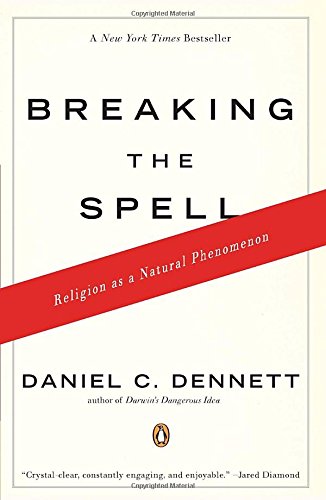
Breaking the Spell: Religion as a Natural Phenomenon, by Daniel C. Dennett

Ebook Breaking the Spell: Religion as a Natural Phenomenon, by Daniel C. Dennett
Reserve Breaking The Spell: Religion As A Natural Phenomenon, By Daniel C. Dennett is one of the valuable worth that will certainly make you constantly rich. It will not imply as abundant as the money give you. When some people have lack to deal with the life, individuals with several publications in some cases will be better in doing the life. Why should be e-book Breaking The Spell: Religion As A Natural Phenomenon, By Daniel C. Dennett It is actually not implied that publication Breaking The Spell: Religion As A Natural Phenomenon, By Daniel C. Dennett will certainly give you power to get to everything. Guide is to review and what we suggested is the book that is checked out. You can additionally see exactly how the publication entitles Breaking The Spell: Religion As A Natural Phenomenon, By Daniel C. Dennett and also numbers of e-book collections are giving below.
There is no question that book Breaking The Spell: Religion As A Natural Phenomenon, By Daniel C. Dennett will certainly always offer you motivations. Also this is just a publication Breaking The Spell: Religion As A Natural Phenomenon, By Daniel C. Dennett; you could locate lots of styles as well as types of publications. From amusing to experience to politic, as well as sciences are all given. As what we specify, right here we offer those all, from popular authors and publisher in the world. This Breaking The Spell: Religion As A Natural Phenomenon, By Daniel C. Dennett is one of the compilations. Are you interested? Take it currently. How is the way? Find out more this write-up!
When someone needs to visit the book shops, search store by store, shelf by shelf, it is quite bothersome. This is why we provide guide compilations in this internet site. It will reduce you to look guide Breaking The Spell: Religion As A Natural Phenomenon, By Daniel C. Dennett as you like. By searching the title, publisher, or writers of guide you desire, you can discover them quickly. Around the house, office, and even in your way can be all finest area within internet connections. If you wish to download the Breaking The Spell: Religion As A Natural Phenomenon, By Daniel C. Dennett, it is extremely simple after that, since currently we proffer the connect to acquire and also make deals to download Breaking The Spell: Religion As A Natural Phenomenon, By Daniel C. Dennett So simple!
Interested? Certainly, this is why, we suppose you to click the web link page to go to, and after that you can delight in guide Breaking The Spell: Religion As A Natural Phenomenon, By Daniel C. Dennett downloaded and install till finished. You could conserve the soft file of this Breaking The Spell: Religion As A Natural Phenomenon, By Daniel C. Dennett in your gizmo. Obviously, you will bring the gadget all over, won't you? This is why, whenever you have spare time, every single time you can enjoy reading by soft copy publication Breaking The Spell: Religion As A Natural Phenomenon, By Daniel C. Dennett
The New York Times bestseller – a “crystal-clear, constantly engaging” (Jared Diamond) exploration of the role that religious belief plays in our lives and our interactions
For all the thousands of books that have been written about religion, few until this one have attempted to examine it scientifically: to ask why—and how—it has shaped so many lives so strongly. Is religion a product of blind evolutionary instinct or rational choice? Is it truly the best way to live a moral life? Ranging through biology, history, and psychology, Daniel C. Dennett charts religion’s evolution from “wild” folk belief to “domesticated” dogma. Not an antireligious screed but an unblinking look beneath the veil of orthodoxy, Breaking the Spell will be read and debated by believers and skeptics alike.
- Sales Rank: #45887 in Books
- Brand: Penguin Books
- Published on: 2007-02-06
- Released on: 2007-02-06
- Original language: English
- Number of items: 1
- Dimensions: 8.40" h x .90" w x 5.40" l, .94 pounds
- Binding: Paperback
- 464 pages
- Great product!
From Publishers Weekly
In his characteristically provocative fashion, Dennett, author of Darwin's Dangerous Idea and director of the Center for Cognitive Studies at Tufts University, calls for a scientific, rational examination of religion that will lead us to understand what purpose religion serves in our culture. Much like E.O. Wilson (In Search of Nature), Robert Wright (The Moral Animal), and Richard Dawkins (The Selfish Gene), Dennett explores religion as a cultural phenomenon governed by the processes of evolution and natural selection. Religion survives because it has some kind of beneficial role in human life, yet Dennett argues that it has also played a maleficent role. He elegantly pleads for religions to engage in empirical self-examination to protect future generations from the ignorance so often fostered by religion hiding behind doctrinal smoke screens. Because Dennett offers a tentative proposal for exploring religion as a natural phenomenon, his book is sometimes plagued by generalizations that leave us wanting more ("Only when we can frame a comprehensive view of the many aspects of religion can we formulate defensible policies for how to respond to religions in the future"). Although much of the ground he covers has already been well trod, he clearly throws down a gauntlet to religion. (Feb. 6)
Copyright © Reed Business Information, a division of Reed Elsevier Inc. All rights reserved.
From Scientific American
If nowhere else, the dead live on in our brain cells, not just as memories but as programs— computerlike models compiled over the years capturing how the dearly departed behaved when they were alive. These simulations can be remarkably faithful. In even the craziest dreams the people we know may remain eerily in character, acting as we would expect them to in the real world. Even after the simulation outlasts the simulated, we continue to sense the strong presence of a living being. Sitting beside a gravestone, we might speak and think for a moment that we hear a reply. In the 21st century, cybernetic metaphors provide a rational grip on what prehistoric people had every reason to think of as ghosts, voices of the dead. And that may have been the beginning of religion. If the deceased was a father or a village elder, it would have been natural to ask for advice—which way to go to find water or the best trails for a hunt. If the answers were not forthcoming, the guiding spirits could be summoned by a shaman. Drop a bundle of sticks onto the ground or heat a clay pot until it cracks: the patterns form a map, a communication from the other side. These random walks the gods prescribed may indeed have formed a sensible strategy. The shamans would gain in stature, the rituals would become liturgies, and centuries later people would fill mosques, cathedrals and synagogues, not really knowing how they got there. With speculations like these, scientists try to understand what for most of the world’s population needs no explanation: why there is this powerful force called religion. It is possible, of course, that the world’s faiths are triangulating in on the one true God. But if you forgo that leap, other possibilities arise: Does banding together in groups and acting out certain behaviors confer a reproductive advantage, spreading genes favorable to belief? Or are the seeds of religion more likely to be found among the memes—ideas so powerful that they leap from mind to mind? In Breaking the Spell: Religion as a Natural Phenomenon, Daniel Dennett, director of the Center for Cognitive Studies at Tufts University, has embarked on another of his seemingly impossible quests. His provocatively titled book Consciousness Explained made a persuasive effort to do just that. More recently, in Freedom Evolves, he took on free will from a Darwinian perspective. This time he may have assumed the hardest task of all—and not just because of the subject matter. Dennett hopes that this book will be read not just by atheists and agnostics but by the religiously faithful—and that they will come to see the wisdom of analyzing their deepest beliefs scientifically, weeding out the harmful from the good. The spell he hopes to break, he suggests, is not religious belief itself but the conviction that its details are off-limits to scientific inquiry, taboo. "I appreciate that many readers will be profoundly distrustful of the tack I am taking here," he writes. "They will see me as just another liberal professor trying to cajole them out of some of their convictions, and they are dead right about that—that’s what I am, and that’s exactly what I am trying to do." This warning comes at the end of a long, two-chapter overture in which Dennett defends the idea that religion is a fit subject for scrutiny. The question is how many of the faithful will follow him that far. For those who do not need to be persuaded, the main draw here is a sharp synthesis of a library of evolutionary, anthropological and psychological research on the origin and spread of religion. Drawing on thinkers such as Pascal Boyer (whose own book is called Religion Explained) and giving their work his own spin, Dennett speculates how a primitive belief in ghosts might have given rise to wind spirits and rain gods, wood nymphs and leprechauns. The world is a scary place. What else to blame for the unexpected than humanlike beings lurking behind the scenes? The result would be a cacophony of superstitions— memes vying with memes—some more likely to proliferate than others. In a world where agriculture was drawing people to aggregate in larger and larger settlements, it would be beneficial to believe you had been commanded by a stern god to honor and protect your neighbors, those who share your beliefs instead of your DNA. Casting this god as a father figure also seems like a natural. Parents have a genetic stake in giving their children advice that improves their odds for survival. You’d have less reason to put your trust in a Flying Spaghetti Monster. At first this winnowing of ghost stories would be unconscious, but as language and self-awareness developed, some ideas would be groomed and domesticated. Folk religion would develop into organized religion, Dennett suggests, somewhat the way folk music bloomed into the music of today. The metaphor is hard to resist. "Every minister in every faith is like a jazz musician," he writes, "keeping traditions alive by playing the beloved standards the way they are supposed to be played, but also incessantly gauging and deciding, slowing the pace or speeding up, deleting or adding another phrase to a prayer, mixing familiarity and novelty in just the right proportions to grab the minds and hearts of the listeners in attendance." Like biological parasites, memes are not necessarily dependent on the welfare of their hosts. One of the most powerful fixations, and one that may have Dennett flummoxed, is that it is sacrilegious to question your own beliefs and an insult for anyone else to try. "What a fine protective screen this virus provides," he observes, "permitting it to shed the antibodies of skepticism effortlessly!" Asides like this seem aimed more at fellow skeptics than at the true believers Dennett hopes to unconvert. A better tack might be for him to start his own religion. Meanwhile his usual readers can deepen their understanding with another of his penetrating books.
George Johnson, a 2005 Templeton-Cambridge Journalism Fellow in Science and Religion, is author of Fire in the Mind: Science, Faith, and the Search for Order and six other books.
From Bookmarks Magazine
The debate about Daniel C. Dennett's new book has been lively from the get-go. Dennett has already had cause to respond to the New York Times regarding Leon Wielseltier's reduction of his book to "a merry anthology of contemporary superstitions." Wielseltier's charge of scientism ("the view that science can explain all human conditions") is one that Dennett admits wholeheartedly; the author of Consciousness Explained (1991) and Darwin's Dangerous Idea (1995) just doesn't care to have his philosophy so summarily dismissed as an "ism." In fact, honest criticism about the book is obscured by the attack on Dennett's ideas. Most reviewers concur that Breaking the Spell presents an intriguing argument for the scientific investigation of religion but that the author's difficult prose and prejudices bog it down.
Copyright © 2004 Phillips & Nelson Media, Inc.
Most helpful customer reviews
8 of 8 people found the following review helpful.
From Cradle Catholic to a Pseudo Religion to a Skeptic
By Steven Haack
I am posting a letter that I wrote to my siblings as a review of this "enlightening book."
Dear J & J,
Friday night, I decided to slowly read through a book on "religion as a natural phenomenon. As long as I have been in religious circles, no one has attempted to explain to me or even discuss where this idea of religion originated. However, not all religions are the same in regards to intent. Dr. Dennett wrote that sharks and dolphins may have similar attributes and can swim in the same waters, however, as often observed, the shark’s intent is definitely not the same as a dolphin.
In his book “Breaking the Spell” by Daniel C. Dennett wrote “Religious cults (or pseudo religions) and political fanatics are not the only casters of evil spells today. Think of the people who are addicted to drugs, or gambling, or alcohol, or child pornography.” Dr. Dennett also states that religion in America is not the same as religions in other countries.
It seems that religion is important to most of our family members and many Americans. Just look at all the televangelists begging for money and getting it. I might suggest that all of us step back and look at the idea of what is religion in the first place. I suggest not waiting until you are lying in bed sick or lying in bed dying before you attempt to understand this idea of religion. Just because it has been handed down to us through traditions does not make it correct in the first place.
In fact, Jesus practiced a lesson similar to Socrates; as a teacher, he never put someone down because a student does not agree. Thomas is known as doubting Thomas and Jesus never put him down; I prefer to call Thomas a skeptic. In my experience, healthy skepticism might have kept me from participating in a pseudo religion for thirteen years. In my view, healthy skepticism is another way of saying "intellectual honesty." One thing I know for sure is that nothing in life to a human is certain, nothing. None of us really knows anything for sure.
This book is well worth the read for true believers and skeptics.
Good luck to you all.
Steven L. H.
6 of 6 people found the following review helpful.
Great Ideas, Weak Delivery
By David Swan
Let me start by saying that Daniel Dennett and I are on the same side of the intellectual fight but as a reviewer I need to be honest in my assessment. There are many ways one might going about selling atheism. In the case of Sam Harris he seems more interested in lobbing bombs and roiling the troops than actually persuading the other side. Christopher Hitchens was an equally heavy hitter but he was much more charismatic and a terrific showman. Even those who virulently opposed Hitchens views were often entertained. By contrast, Dennett is much more professorial. After watching a bunch of Hitchens debates it was clear he crafted his message and went for audience responses. Dennett’s book feels more like a college lecture. Don’t get me wrong, his message is great and sometimes brilliant but this book desperately needed some paring down and added punch.
Daniel Dennett is an intellectual, not a showman. The title ‘Breaking the Spell’ refers to the idea of pulling back the curtain on religion and exposing it as a myth and he compares it to the realization that Santa Claus isn’t real. The entire first chapter is devoted to the question of whether it is ethically responsible to study religion in a scientific manner and the chapter is long and not the least bit riveting. Dennett is so long winded that I frequently find myself zoning out. He circles the block over and over just to get to his destination when he could have just stated his point and moved on. As an example of how unconnected it sometimes feels like Dennett is he defended the ‘Bright’ movement, a movement I found to be ludicrous and embarrassing. Unsurprisingly I never really hear anyone using the term “bright” anymore.
There is a lot of good ideas in the book that I’m sure contemplative atheists will find themselves agreeing with. His book contains intellectual ammunition that atheists can use to defend their own beliefs or punch holes in the beliefs of religionists. He also remains casual enough not to immediately chase away anyone sitting on the fence. I just wish the book had been more engrossing and less dry and dusty.
5 of 5 people found the following review helpful.
"Breaking the Spell" by Daniel Dennett
By weston
It is not surprising that superstitions and creation myths passed down from prehistory evolved into the Abrahamic religions (Judaism, Christianity, Muslim) with an omnipotent and caring, but incomprehensible, god that created heaven and earth in six days some six thousand years ago and has been listening to our individual prayers ever since. Religion has probably been a net-positive effect in mankind's development, in particular for those (shamen, prophets, imams, bishops and popes) who would strive to pass themselves off as the earthly representatives of such a god. What is surprising is that these ancient superstitions still play such a large and largely pernicious role in mankind's life today, three centuries after the enlightenment and a century after geology and physics have established the age of the earth at 4.6 billion years and the age of the heavens at 13.8 billion years. It is not hard to understand the motivation of these latter-day shamen, who accrue power and wealth thereby, but why do the rest of us, who provide this wealth and power, continue to buy in to these ancient superstitions in the face of clear and contrary scientific evidence?
Religion obviously meets some basic human need that makes most of us willing to overlook its contradictions and transgressions. This book calls for a study of those needs and of how religion satisfies them. The author, a prominent philosophy professor, puts forward a proposal to study religion "scientifically" as a natural phenomenon, and discusses a number of biological, neuroscientific, anthropological, social science and other soft-science investigations that might be undertaken to this end. That is a very good idea, but, as the author acknowledges, it is unlikely that politically powerful religious authorities would submit to such studies, but would more likely continue to respond that religion must be taken on faith and can not be understood by science.
I agree with the author that religion could be studied using the methods of science, but would probably come up with a somewhat different set of scientific methods. In particular, this book puts much emphasis on the currently fashionable "evolution- run-amok" theory made prominent by Richard Dawkins' extension of Darwin's evolutionary theory of trial and error and survival of the fittest to impugn to "selfish" genes, and later to intellectual concepts which he called "memes", a will to propagate themselves. Religions have only existed for an instant on the evolutionary time scale. There is quite a professional (philosophy) literature cited, but most of it is not what I would consider scientific.
Breaking the Spell: Religion as a Natural Phenomenon, by Daniel C. Dennett PDF
Breaking the Spell: Religion as a Natural Phenomenon, by Daniel C. Dennett EPub
Breaking the Spell: Religion as a Natural Phenomenon, by Daniel C. Dennett Doc
Breaking the Spell: Religion as a Natural Phenomenon, by Daniel C. Dennett iBooks
Breaking the Spell: Religion as a Natural Phenomenon, by Daniel C. Dennett rtf
Breaking the Spell: Religion as a Natural Phenomenon, by Daniel C. Dennett Mobipocket
Breaking the Spell: Religion as a Natural Phenomenon, by Daniel C. Dennett Kindle

Tidak ada komentar:
Posting Komentar